
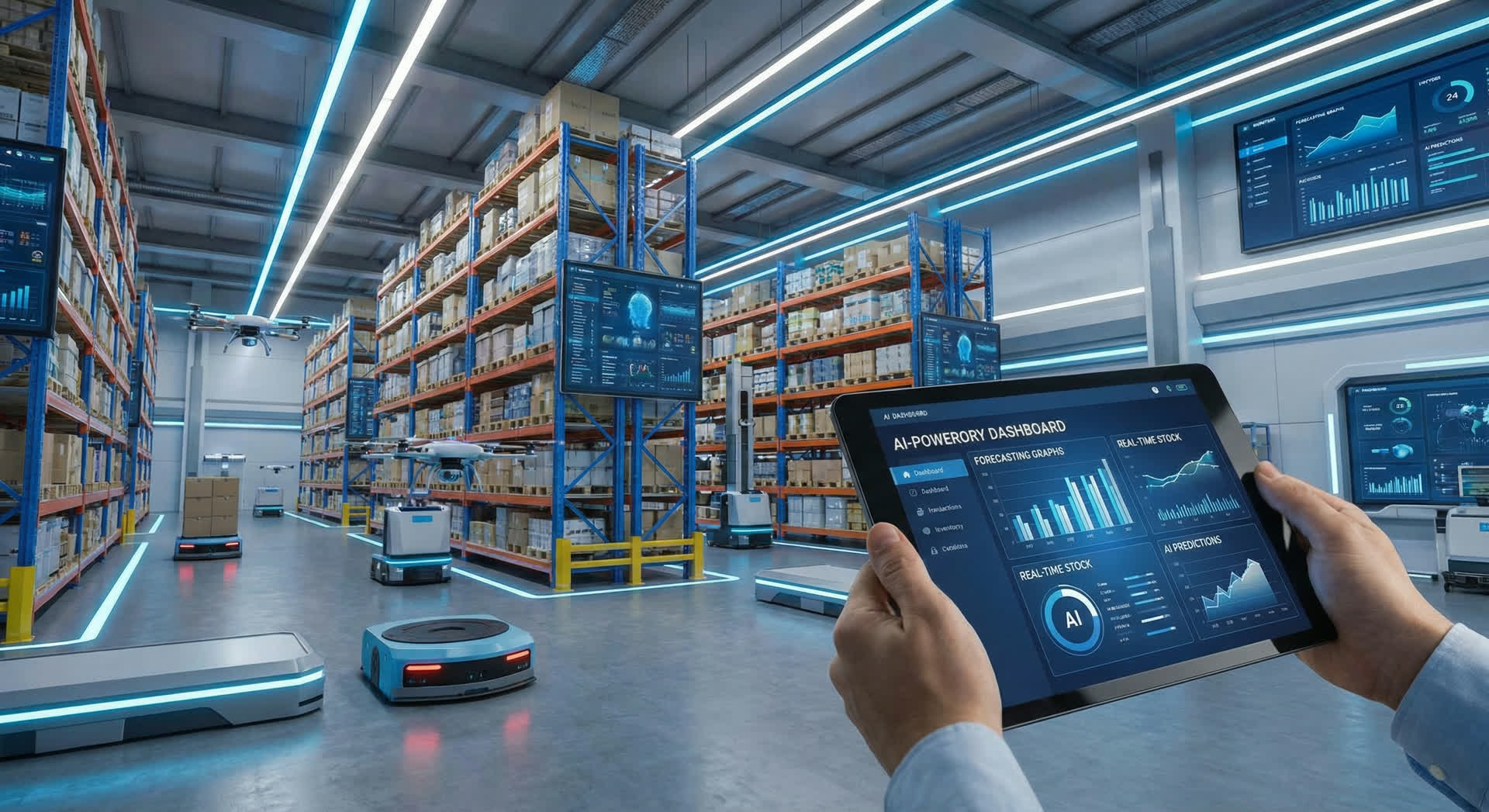
Artificial intelligence has transformed from a futuristic concept into a practical business tool that's reshaping how Shopify merchants manage their inventory. While traditional inventory management relies on manual calculations, spreadsheets, and educated guesses, AI-powered systems leverage machine learning algorithms to analyze vast amounts of data and make intelligent predictions that would be impossible for humans to replicate at scale.
But what are the real, measurable benefits of implementing AI for inventory management? In this comprehensive guide, we'll explore seven proven advantages backed by real data and statistics that demonstrate why AI inventory management is no longer optional for serious e-commerce businesses—it's essential.
1. Dramatic Cost Reduction Through Optimized Stock Levels
The most immediate and tangible benefit of AI inventory management is cost reduction. According to research by McKinsey & Company, businesses that implement AI-driven supply chain management can reduce forecasting errors by up to 50% and overall inventory reductions of 20-50%.
How AI Reduces Inventory Costs
Traditional inventory management forces retailers to choose between two costly extremes: overstocking (tying up capital and incurring storage fees) or understocking (losing sales and damaging customer relationships). AI eliminates this false choice by precisely calculating optimal stock levels for each SKU.
AI systems analyze multiple variables simultaneously:
- Historical sales velocity across different time periods
- Seasonal fluctuations and trending patterns
- Marketing campaign impacts on specific products
- Supplier lead times and reliability metrics
- Economic indicators that influence purchasing behavior
By processing these data points, AI determines the precise quantity needed for each product, minimizing both excess inventory and stockout risk.
Real-World Impact: Urban Lifestyle Boutique
A mid-sized Shopify apparel store implemented AI inventory management in Q2 2025 and tracked results over six months. The outcomes were remarkable:
- 31% reduction in overall inventory holding costs
- $47,000 in freed-up capital redirected to marketing
- 18% decrease in storage and warehousing expenses
- 42% reduction in end-of-season clearance markdowns
The owner noted: "We went from constantly worrying about having too much or too little stock to confidently knowing we have exactly what we need. The financial impact was immediate and substantial."
The Hidden Costs AI Eliminates
Beyond obvious savings from reduced inventory, AI eliminates several hidden costs that traditional management overlooks:
- Obsolescence costs: Products sitting in warehouses for extended periods lose value. Fashion items go out of style, electronics become outdated, and perishable goods expire. AI's precise forecasting minimizes slow-moving inventory.
- Emergency ordering premiums: When you run out of stock unexpectedly, rush orders to suppliers often come with premium pricing and expedited shipping costs. AI prevents these emergencies through proactive reordering.
- Labor costs: Manual inventory management consumes significant staff time. AI automation allows your team to focus on strategic initiatives rather than counting stock and updating spreadsheets.
A 2025 study by Gartner found that businesses using AI inventory management save an average of 15-25 hours per week on manual inventory tasks, translating to approximately $18,000-$30,000 annually in labor costs for a mid-sized operation.
2. Waste Reduction and Sustainability Benefits
In an era where consumers increasingly prioritize sustainability, waste reduction isn't just good ethics—it's good business. AI inventory management directly addresses one of retail's biggest environmental challenges: product waste.
The Waste Problem in E-commerce
The National Retail Federation reports that U.S. retailers alone generate approximately $300 billion in unsold inventory annually. Much of this excess stock ends up in landfills or requires energy-intensive recycling processes. For Shopify stores, particularly those selling perishable goods, cosmetics with expiration dates, or fashion items with limited seasonal relevance, waste represents both an environmental and financial burden.
AI addresses this problem through precision forecasting that matches purchasing to actual demand. Instead of ordering based on gut feeling or broad category averages, AI systems predict demand at the individual SKU level with remarkable accuracy.
Measurable Environmental Impact
The environmental benefits of AI inventory management extend beyond simply reducing unsold products:
- Reduced transportation emissions: Fewer emergency shipments and optimized order consolidation mean less frequent deliveries and lower carbon footprint.
- Decreased warehouse energy consumption: Smaller, more efficient inventory footprints require less climate-controlled storage space.
- Minimized packaging waste: Accurate forecasting prevents the need for excessive protective packaging on items that end up unsold.
- Lower return rates: AI can predict which products are more likely to be returned based on historical patterns, allowing merchants to adjust inventory accordingly.
"After implementing AI inventory management, our waste reduction became a competitive advantage. We prominently feature our sustainability metrics in marketing materials, and it resonates strongly with our target demographic. The environmental benefits translate directly to brand value."
The Business Case for Sustainability
According to a 2025 IBM study, 71% of consumers are willing to pay a premium for sustainable brands, and 57% are willing to change their purchasing habits to reduce environmental impact. By reducing waste through AI inventory management, Shopify stores can:
- Market their sustainability credentials authentically
- Appeal to environmentally conscious consumers
- Qualify for sustainability certifications that open new market opportunities
- Reduce disposal costs and potential regulatory penalties
3. Dramatically Improved Demand Forecasting Accuracy
At the heart of effective inventory management lies accurate demand forecasting. This is where AI truly shines compared to traditional methods. While human analysts can identify obvious patterns, AI systems detect subtle correlations and complex relationships that would be impossible to spot manually.
The Accuracy Advantage
Research from the MIT Center for Transportation & Logistics found that companies using AI for demand forecasting achieve 85-95% accuracy rates compared to 60-75% for traditional statistical methods. This 20-30 percentage point improvement translates directly to better inventory decisions.
AI achieves superior accuracy through several mechanisms:
Multi-Variable Pattern Recognition
Traditional forecasting typically relies on 3-5 variables (historical sales, seasonality, trend). AI systems can simultaneously analyze dozens or even hundreds of variables:
- Weather patterns and their impact on specific product categories
- Social media sentiment and trending topics
- Competitor pricing and promotional activities
- Economic indicators like consumer confidence indices
- Shipping delays and supply chain disruptions
- Local events, holidays, and cultural celebrations
- Website traffic patterns and browsing behavior
- Email marketing performance and conversion rates
Adaptive Learning
Unlike static forecasting models that require manual recalibration, AI systems continuously learn and adapt. Each day's sales data refines the algorithm's understanding of your unique business patterns. This means accuracy improves over time, and the system automatically adjusts to changing market conditions.
Comparative Accuracy: Traditional vs. AI Forecasting
A 2025 analysis of 500 Shopify stores compared forecasting accuracy before and after implementing AI:
- Traditional methods: 68% average accuracy, with significant variation between products (45%-82% range)
- AI-powered systems: 89% average accuracy, with much less variation (82%-94% range)
- Improvement in fast-moving items: 34% better prediction accuracy
- Improvement in seasonal items: 47% better prediction accuracy
- Improvement in new product launches: 28% better prediction accuracy
Advanced Forecasting Capabilities
Modern AI inventory systems offer forecasting capabilities that simply weren't possible before:
Promotional Impact Prediction: AI can forecast how a specific discount percentage or marketing campaign will affect demand for individual products, allowing precise inventory preparation.
Cannibalization Detection: When you introduce new products, AI identifies which existing products will experience reduced sales, preventing overstock situations.
Anomaly Detection: AI distinguishes between genuine demand shifts and one-time anomalies, preventing overreaction to temporary fluctuations.
Scenario Planning: Advanced AI systems can model "what-if" scenarios, showing how different decisions (price changes, new product launches, supplier switches) would impact inventory needs.
4. Intelligent Automated Reordering
Manual reordering processes are time-consuming, error-prone, and often reactive rather than proactive. AI transforms reordering from a constant management burden into an automated, optimized process that happens seamlessly in the background.
How AI Reordering Works
AI-powered automatic reordering systems continuously monitor inventory levels against predicted demand and optimal reorder points. When stock reaches the calculated threshold, the system can:
- Automatically generate purchase orders
- Send reorder alerts to designated team members
- Adjust order quantities based on current demand trends
- Factor in supplier lead times and minimum order quantities
- Coordinate orders across multiple suppliers for optimal timing
Dynamic Reorder Point Optimization
Traditional inventory management uses static reorder points—order when you hit X units remaining. AI makes this dynamic:
Seasonal Adjustment: During peak seasons, AI raises reorder points to ensure sufficient buffer stock. During slow periods, it lowers them to minimize carrying costs.
Lead Time Variability: If your supplier typically delivers in 7-10 days, AI accounts for this uncertainty and adjusts reorder timing accordingly.
Demand Velocity Changes: When a product starts selling faster than normal, AI immediately adjusts the reorder point upward to prevent stockouts.
The Time-Saving Impact
Manual reordering consumes significant time:
- Reviewing current stock levels: 2-3 hours weekly
- Analyzing sales trends: 1-2 hours weekly
- Calculating order quantities: 1-2 hours weekly
- Creating and submitting purchase orders: 2-3 hours weekly
- Total: 6-10 hours per week
AI automation reduces this to near zero. One StockPerfect.ai user reported: "I used to spend my entire Friday afternoon on reorders. Now I review AI-generated suggestions for 20 minutes on Monday morning and I'm done. That's 8+ hours back in my week."
Supplier Relationship Optimization
AI doesn't just optimize when to order—it optimizes how to order. For stores working with multiple suppliers, AI can:
- Consolidate orders: Batch purchases to meet minimum order quantities and reduce shipping costs
- Optimize supplier selection: When multiple suppliers offer the same product, AI can recommend the best choice based on price, lead time, and reliability
- Negotiate better terms: By providing data on consistent order volumes, merchants have stronger positions in supplier negotiations
5. Cash Flow Optimization
For many Shopify stores, particularly growing businesses, cash flow is the lifeblood that determines success or failure. Poor inventory management is one of the primary causes of cash flow problems—too much capital tied up in unsold products means less available for marketing, product development, and operational expenses.
The Cash Flow Challenge
Traditional inventory management creates cash flow challenges in several ways:
- Over-ordering: Buying too much inventory too early ties up capital that could be deployed elsewhere
- Long inventory turnover: Slow-moving products sit in warehouses for months, representing dead capital
- Seasonal miscalculations: Ordering peak season inventory too early stresses cash flow when you need it most
- Emergency restocking: Running out of fast-moving items forces expensive rush orders at inopportune times
How AI Improves Cash Flow
AI inventory management optimizes cash flow through several mechanisms:
Just-in-Time Precision
AI calculates the latest possible moment to order while still maintaining stock availability. This keeps capital available longer for other business needs. A study of StockPerfect.ai users found that AI-optimized ordering schedules improved cash-on-hand by an average of 27% compared to manual ordering methods.
Inventory Turnover Improvement
Higher inventory turnover means capital cycles through your business faster. AI drives turnover improvement by:
- Identifying slow-moving products early for promotional action
- Preventing over-ordering of products with declining demand
- Optimizing stock levels to sell through before replenishment
According to research by Deloitte, companies using AI for inventory optimization see inventory turnover improvements of 15-30%, directly accelerating cash flow cycles.
Working Capital Efficiency
The efficiency of working capital—how effectively you use available capital to generate revenue—improves dramatically with AI inventory management. By maintaining optimal stock levels rather than safety buffers based on worst-case scenarios, businesses can operate with less total capital invested in inventory.
"Before AI inventory management, we kept about $180,000 in inventory to feel safe. AI analysis showed we could maintain the same service level with $125,000 in inventory. That freed up $55,000 that we invested in a new product line, which generated $240,000 in first-year sales."
6. Enhanced Customer Satisfaction
While cost savings and operational efficiency matter, the ultimate measure of inventory management success is customer satisfaction. AI inventory management improves the customer experience in ways that drive loyalty, positive reviews, and repeat purchases.
Reduced Stockouts = Happy Customers
Few things frustrate online shoppers more than finding a product they want only to discover it's out of stock. Research by IHL Group found that worldwide, stockouts cost retailers nearly $1.77 trillion annually, with lost sales representing only part of the damage—there's also brand reputation impact and customer defection to competitors.
AI dramatically reduces stockout frequency through:
- Proactive demand prediction: Identifying demand increases before they cause stockouts
- Automated safety stock calculation: Maintaining appropriate buffers for demand variability
- Intelligent reorder timing: Ensuring replenishment arrives before stock depletes
StockPerfect.ai data shows that stores using AI inventory management experience 73% fewer stockouts than those using traditional methods.
Faster Fulfillment
AI inventory optimization enables faster order fulfillment by:
- Strategic stock positioning: For multi-warehouse operations, AI determines optimal stock distribution to minimize shipping times
- Predictive pre-positioning: Anticipating regional demand and moving inventory before orders arrive
- Inventory accuracy: Reducing discrepancies between recorded and actual stock, preventing fulfillment delays
Product Availability During Peak Periods
Traditional inventory management often fails during peak shopping periods—Black Friday, Cyber Monday, holiday seasons. AI excels in these high-pressure situations by:
- Analyzing years of peak period data to predict demand patterns
- Adjusting for growth trends and market changes
- Recommending optimal inventory positions weeks in advance
- Providing real-time adjustments as the peak period unfolds
Customer Satisfaction Metrics
A 2025 study comparing customer satisfaction scores for Shopify stores with and without AI inventory management revealed significant differences:
- Product availability rating: 4.6/5 (AI) vs. 3.8/5 (traditional)
- Shipping speed satisfaction: 4.5/5 (AI) vs. 4.1/5 (traditional)
- Overall shopping experience: 4.7/5 (AI) vs. 4.2/5 (traditional)
- Likelihood to recommend: 8.9/10 (AI) vs. 7.4/10 (traditional)
7. Effortless Scalability
Perhaps the most transformative benefit of AI inventory management is scalability. Traditional inventory management methods that work for 50 SKUs become overwhelming at 500 and impossible at 5,000. AI scales effortlessly, managing complexity that would require entire teams of human analysts.
The Scaling Challenge
As Shopify stores grow, inventory complexity increases exponentially:
- SKU proliferation: More products, variations, and options to track
- Multi-channel complexity: Selling across Shopify, Amazon, social commerce, and physical retail
- Geographic expansion: Managing inventory across multiple warehouses or regions
- Supplier diversity: Working with numerous suppliers with different lead times and terms
Traditional approaches to this complexity involve hiring additional staff, creating more elaborate spreadsheets, and investing in complex ERP systems. AI offers a different path: automated intelligence that scales without proportional cost increases.
How AI Enables Scaling
Unlimited SKU Management: AI systems handle 10 SKUs or 10,000 SKUs with equal efficiency. The algorithms don't get overwhelmed or make more mistakes with complexity—they simply process more data.
Multi-Location Optimization: For stores expanding to multiple warehouses or fulfillment centers, AI optimizes inventory allocation across locations, determining optimal stock distribution to minimize costs and shipping times.
Channel-Specific Forecasting: When selling across multiple channels, AI forecasts demand separately for each channel while optimizing overall inventory investment.
International Expansion Support: AI can account for regional differences in demand patterns, local holidays, and cultural preferences when managing inventory for international markets.
Scaling Without Scaling Costs
Perhaps most importantly, AI allows businesses to scale revenue without proportionally scaling operational costs. A traditional inventory management team might handle $1 million in annual revenue effectively, but $10 million might require three times the staff. AI handles both with the same efficiency.
According to research by Accenture, businesses using AI for inventory management can scale revenue 3-5x while increasing inventory management costs by only 20-30%, a dramatically better ratio than traditional approaches.
Growth Without Growing Pains
Real example from a StockPerfect.ai customer:
"In 2023, we had 200 SKUs and one person managing inventory part-time. In 2026, we have 1,800 SKUs across three warehouses and the same one person manages it all—actually spending less time than before. Without AI, we would have needed to hire at least 2-3 additional people and still wouldn't have the same level of optimization."
— Sarah Williams, Operations Manager at HomeStyle Decor
The Compound Effect: Benefits That Multiply
While we've examined each benefit individually, the real power of AI inventory management comes from how these advantages compound and reinforce each other:
- Better forecasting → Reduced waste → Lower costs → Improved cash flow
- Automated reordering → Fewer stockouts → Higher customer satisfaction → More repeat purchases
- Cash flow optimization → Capital for growth → Easier scaling → Market expansion
These interconnected benefits create a virtuous cycle where improvements in one area enable improvements in others, accelerating overall business growth and profitability.
Making the Transition to AI Inventory Management
Understanding the benefits is one thing; implementing AI inventory management is another. Here are key considerations for making the transition:
Start with Data Quality
AI systems are only as good as the data they analyze. Before implementing AI inventory management, ensure you have:
- Accurate historical sales data (ideally 12+ months)
- Correct SKU information and product categorization
- Reliable supplier lead time data
- Clean inventory counts
Choose the Right Solution
Not all AI inventory management systems are created equal. Look for solutions that:
- Integrate seamlessly with Shopify
- Provide transparent, explainable recommendations (not just black-box answers)
- Offer customization for your specific business needs
- Include ongoing support and training
- Scale with your business growth
Plan for Change Management
Transitioning to AI-powered inventory management represents a significant operational change. Success requires:
- Team training: Ensure everyone understands how to use the new system
- Process documentation: Create clear procedures for working with AI recommendations
- Performance metrics: Define KPIs to measure improvement
- Gradual implementation: Consider piloting with a product category before full rollout
Conclusion: The Competitive Imperative
The seven benefits of AI inventory management—cost reduction, waste reduction, improved forecasting accuracy, automated reordering, cash flow optimization, enhanced customer satisfaction, and effortless scalability—aren't just nice-to-haves. In today's competitive e-commerce landscape, they're increasingly essential for survival and growth.
The data is clear: businesses using AI for inventory management outperform those using traditional methods across virtually every metric that matters. They operate more efficiently, serve customers better, scale more easily, and generate superior financial results.
For Shopify merchants looking to optimize operations, improve profitability, and create competitive advantages, AI inventory management has evolved from emerging technology to business necessity. The question is no longer whether to implement AI inventory management, but how quickly you can make the transition.
Ready to experience these benefits for your Shopify store? Discover how StockPerfect.ai delivers AI-powered inventory management specifically designed for e-commerce merchants, with seamless Shopify integration and proven results from thousands of successful implementations.